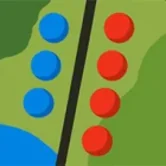
War of Dots
Play War of Dots, a real-time strategy game, free in your browser. No download, no sign-up.
More Games Like This


















You drag your first army from a city you hold toward a neutral one, release, and watch the dots march out before your opponent’s column can get there. In War of Dots that tiny race, repeated across the whole map, is the heartbeat of every match.
| Genre | Real-time strategy |
| Modes | Single-player and multiplayer |
| Main resource | Cities that reinforce your armies |
| Victory | Break the enemy’s armies and take their territory |
Claiming Cities in the Opening Minutes
Every match begins with a few cities under your control and neutral ones scattered between you and the opponent. Cities reinforce your armies, so grabbing nearby ones early grows your force faster. The trap is that every city you take also has to be defended.
Beginners expand in every direction at once and leave their armies spread thin. One counterattack is usually enough to unravel that kind of opening.
Defensive players tend to secure two or three strong cities before pushing outward, while aggressive players sprint for map control and accept the risk. Both work, but the aggressive route punishes a single misread much harder.
Terrain and Frontlines in War of Dots
Terrain shapes every fight. Forests and hills slow movement and help defenders, while open ground lets armies move quickly but leaves them exposed. Choosing where the fight happens often matters more than how many dots you bring.
Holding a river crossing or a narrow pass can stall a much larger force long enough for reinforcements from nearby cities to arrive.
By the middle of a match, frontlines form and the game shifts from racing to positioning. Players who keep a reserve behind the front react to breakthroughs, while those who commit everything forward often watch a single gap collapse the whole line.
Feints, Flanks and Reading the Opponent
Because armies are visible as they move, every push sends a message. A loud attack on one flank is often meant to pull defenders away from the real target, and experienced players spot that pattern quickly.
Provoking an opponent into attacking a well-defended city is a classic tactic, since a failed assault leaves very few dots to hold any ground gained.
The built-in AI becomes predictable after a few matches, and that is a fair complaint. Human opponents adapt much faster, which is why multiplayer matches feel longer and far less scripted.
War of Dots Questions
- How do you win a match in War of Dots? You win by breaking the enemy’s armies and taking their territory, including the cities that reinforce them. Cutting off reinforcements usually ends a match faster than chasing every last army.
- Is fast expansion always the right opening? Only when you can defend what you take. Grabbing neutral cities near your start is smart, but stretching armies across distant cities invites a counterattack that undoes the gain.
- Is the AI or a human opponent harder? The AI is good for learning terrain and city control, but its patterns become readable. Human opponents use feints and flanks that expose weaknesses the AI never tests.
War of Dots rewards patience disguised as aggression, and the players who win consistently know when to stop pushing toward an enemy city and pull back to defend the river crossing that is quietly slipping away.
HTML5 Games Worth Trying Next
Done with War of Dots for now? These play in a similar way: