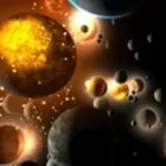
Universe Sandbox 2
Play Universe Sandbox 2, a space physics sandbox game, free in your browser. No download, no sign-up.
More Games Like This



















Universe Sandbox 2 does not treat the Moon as a fixed decoration: grab it, drag it closer to Earth, and the tides, orbits, and eventually the Moon itself respond to gravity in ways you did not plan. This is a physics sandbox for the solar system and beyond, where you build, break, and watch the consequences unfold.
| Genre | Space physics sandbox |
| Core idea | Simulate gravity, collisions, climate and orbits |
| Starting point | The Solar System and dozens of preset simulations |
| Goal | Open-ended experimentation |
Gravity, Orbits and the Solar System Preset
The Solar System preset is where most players begin. The Sun, the eight planets, and major moons all pull on each other, and changing the mass of one body ripples through every orbit around it. Speeding up time shows years of motion in seconds.
Beginners usually push time too far too quickly. At very high time steps the simulation loses accuracy, and close orbits can behave strangely. Slowing down before a close encounter keeps results believable.
Students and curious players use the preset as a hands-on astronomy lesson, while sandbox fans immediately start adding a second Sun to see what breaks.
Collisions and Destruction in Universe Sandbox 2
Smashing planets together is the most famous part of the game. When two bodies collide, the simulation calculates fragments, heat, and the debris field that spreads into space. Earth hit by a large asteroid glows with molten rock before cooling.
The collision settings matter. Higher quality fragmentation looks better but demands more from your computer, so large impacts can slow the frame rate on weaker machines.
That performance cost is a common complaint, especially when players combine many bodies with heavy effects. Lowering fragment counts is the usual workaround.
Climate, Water and Black Holes in Universe Sandbox 2
Earth in the game has surface temperature, water, and ice. Push the planet closer to the Sun and the oceans boil away; move it outward and ice spreads toward the equator. Watching a habitable world ice over is a surprisingly effective lesson in how sensitive climate is.
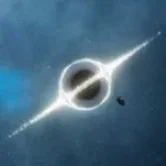
Black holes add another layer. Dropping one into the Solar System shows tidal disruption as planets are stretched and pulled into an accretion disk.
Players who love building tend to design custom star systems, binary stars, and ring worlds, then share them with the community workshop.
Questions Before You Start
- Is Universe Sandbox 2 scientifically accurate? It uses real physics for gravity, collisions, and temperature, though extreme time speeds and simplifications reduce precision in edge cases.
- What should beginners try first? Start with the Solar System preset, then try changing the Moon’s mass or Earth’s distance from the Sun.
- Why does the simulation slow down? Large collisions generate many fragments. Reducing fragment settings or the number of bodies keeps things smooth.
Universe Sandbox 2 turns curiosity into experiments, whether you are icing over Earth’s oceans, dropping a black hole near Jupiter, or simply watching the Moon drift away after one careless drag.
Keep Exploring Simulation Games
Players who open Universe Sandbox 2 often move on to these: